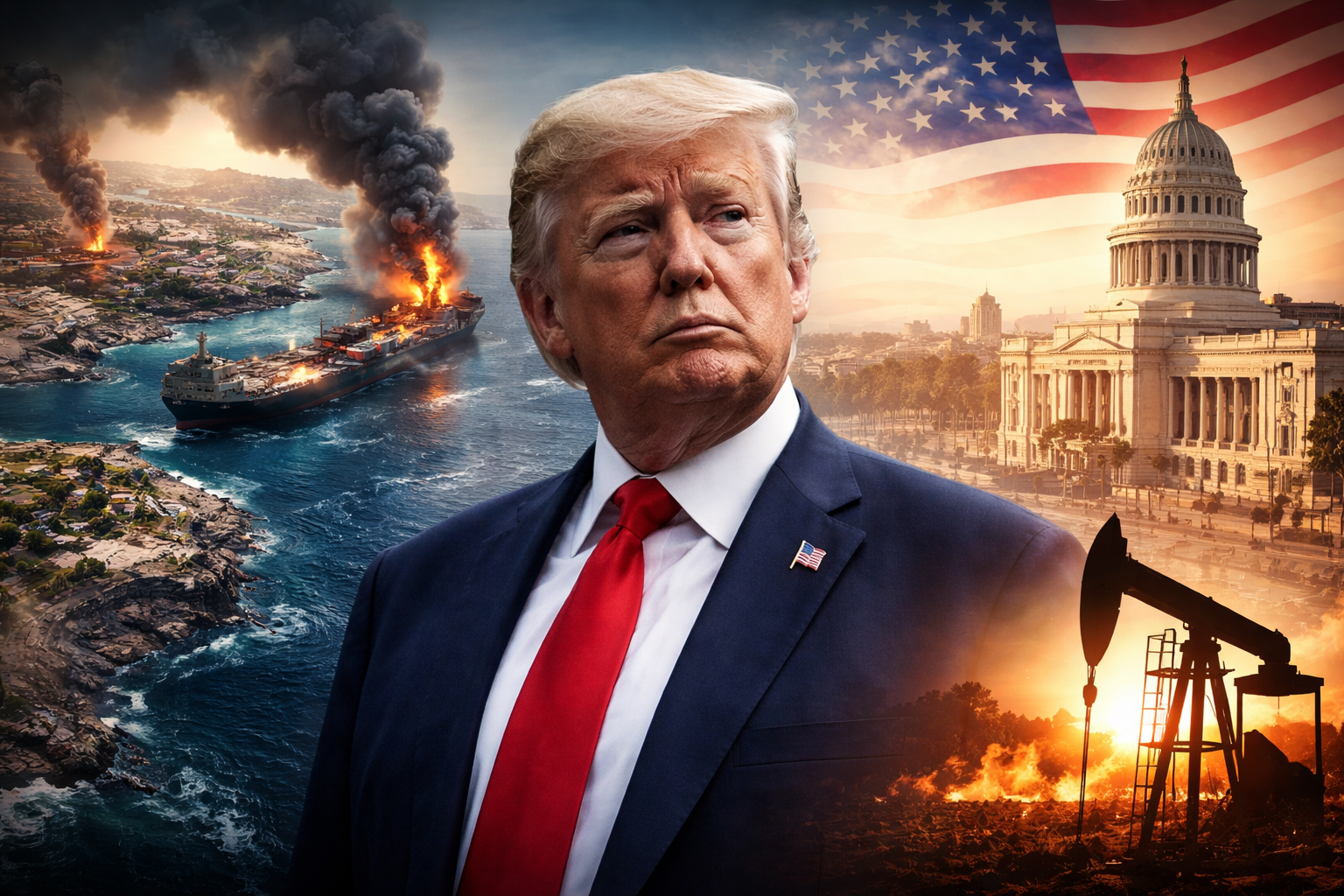
A few months ago, the removal of Venezuela’s president looked like an isolated shock.
Then came pressure on Greenland.
Now there’s a war in the Middle East — and the next chapter already appears to be forming.
Taken together, the pieces suggest something larger is underway.
The United States seems to be redrawing parts of the geopolitical map in ways investors haven’t seen since the end of the Cold War.
For investors trying to gauge what’s next, the key isn’t the latest airstrike or missile barrage. The real story lies in the pattern emerging across regions.
Why Venezuela was the opening move
The capture of Nicolás Maduro after US strikes near Caracas stunned diplomats across Latin America — and sent a clear message.
Venezuela sits on the world’s largest proven oil reserves, estimated by the US Energy Information Administration at about 303 billion barrels, more than Saudi Arabia’s.
It also straddles key Caribbean shipping routes linking the Panama Canal, the Gulf Coast and Europe.
From Washington’s standpoint, the calculus was simple: a hostile government controlling the planet’s largest oil reserves, located in the Western Hemisphere, represents a long-term strategic threat. Removing Maduro shifted that balance overnight.
The old doctrine that never quite vanished
To understand why Venezuela came first, it helps to look back two centuries.
In 1823, the United States declared the Monroe Doctrine — a simple principle that European powers should stay out of the Western Hemisphere.
For much of the 19th and 20th centuries, Washington enforced the policy through diplomacy, economic leverage and, at times, military intervention.
That approach softened after the Cold War as global institutions and trade agreements became the preferred tools of influence. Yet the strategic logic endured.
Latin America remains America’s geopolitical backyard, and foreign powers gaining footholds there have always sparked concern in Washington.
China’s expanding presence across the region has heightened those worries. Chinese banks and companies poured more than $150 billion into Latin America and the Caribbean between 2005 and 2023.
Seen through that lens, Venezuela looks less like an isolated intervention and more like a reminder that the Western Hemisphere still carries strategic weight.
What the Iran war really seeks to achieve
The current conflict with Iran began with coordinated US–Israeli strikes on nuclear facilities and senior officials. Washington has since signalled that regime change in Tehran would be an acceptable outcome.
The fighting has already spread. Iranian missile and drone attacks have hit Gulf states and targeted the US Navy’s Fifth Fleet headquarters in Bahrain.
The campaign’s goal extends beyond Iran’s nuclear programme: to weaken its regional military network and dismantle the political system built since the 1979 revolution.
Reports from inside Iran suggest cracks are appearing.
Some military officers have deserted, and naval crews have surrendered vessels abroad as strikes intensify and senior commanders are killed.
Still, the regime remains standing. Iran’s clerical leadership quickly appointed Mojtaba Khamenei as new supreme leader after his father’s death — a move that hints this war could last far longer than initially expected.
Cuba: where economics becomes the weapon
While Venezuela involved military power, Cuba represents a softer front.
Donald Trump has floated the idea of a “friendly takeover” of the island. The phrase may sound dramatic, but the underlying strategy is economic.
Cuba is facing one of its worst modern crises: electricity shortages, rolling blackouts, food and fuel scarcity.
The collapse of the Venezuelan oil supply after Maduro’s fall deepened the turmoil.
Washington has responded by allowing US energy firms to sell fuel directly to private Cuban businesses, bypassing state-controlled channels and bolstering the island’s small private sector.
Over time, that could reshape Cuba’s economy without a shot being fired. A new class of entrepreneurs linked to US energy, trade and finance may gradually erode the state-run system.
For investors, the implications are striking. Cuba lies 90 miles from Florida and commands sea routes linking the Atlantic and the Gulf of Mexico.
A more open economy there could transform tourism, logistics and energy infrastructure across the Caribbean.
Watching the resource map
Viewed day by day, these events can seem chaotic — Venezuela one week, Cuba the next, Iran dominating headlines after that.
Oil markets have responded swiftly.
Disruptions near the Strait of Hormuz have pushed crude sharply higher, with Brent surging past $100 a barrel and fears of an imminent global energy crunch mounting.
But over a longer horizon, the theme is clear: geography and natural resources still govern global power.
Venezuela holds the world’s largest oil reserves. Iran controls one of the most vital energy chokepoints. Cuba sits at the mouth of the Gulf of Mexico.
Globalisation didn’t erase these truths — it merely made them easier to ignore during years of stability.
Investors fixated on quarterly results risk missing the bigger picture.
Control of energy supply chains, trade routes and raw materials remains the foundation of the global economy.
Political decisions that reshape that control can alter market dynamics for decades.
The post How America’s new power play is rewriting global energy routes appeared first on Invezz
